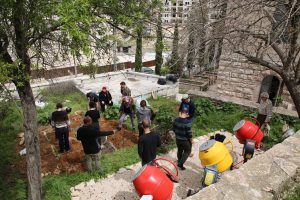
L. Dear Massimo, let’s pick up our dialogue where we left off, a few years ago, in Castiglione d’Otranto when you visited us on the occasion of the rural festival Green Night: agriculture, utopias, and community, to cultivate together the school of common goods. Starting from the analysis of our experience, you were already thinking about the processes of commoning to implement the desired and necessary concept of “restanza” in rural areas. You also brought forward the notion of detritus, as a starting condition for building new narratives and stratification.
M. I believe that the concept of “restanza”, but also the “tornanza”, is often based on an ambivalent subjectivity, reaching out to the new while being rooted in the ancient. “Restanza” is the attitude of those who decide to remain in their own land despite wanting something that it does not offer, and present themselves, with proactive intentions, as a subject of renewal. This is often driven by the desire to care after and transform places and social relationships. Knowing how to read this ambivalence and recognise the sedimentations, the multiple even contradictory facets of those who not only stay but also return, is a richness, a plurality of life paths as a precondition for shared narratives.
Detritus2 is the stratification of waste inscribed in the body and in the environment produced by the subordination of the reproduction of life to that of capital. Going beyond this subordination means building new forms of social cooperation starting from the detritus itself. In rural areas, the condition of detritus experiences a tension between the inherited culture of the peasant populations with their local methods of commoning and the historical extraction of resources and people who have abandoned the villages. This tension is a resource to emphasise, where the detritus (an abandoned farmhouse, an uncultivated land, an ambivalent subject) brings these areas back to life. From this point of view, “restanza”1 means taking control of these conditions and transforming them, making them generative.
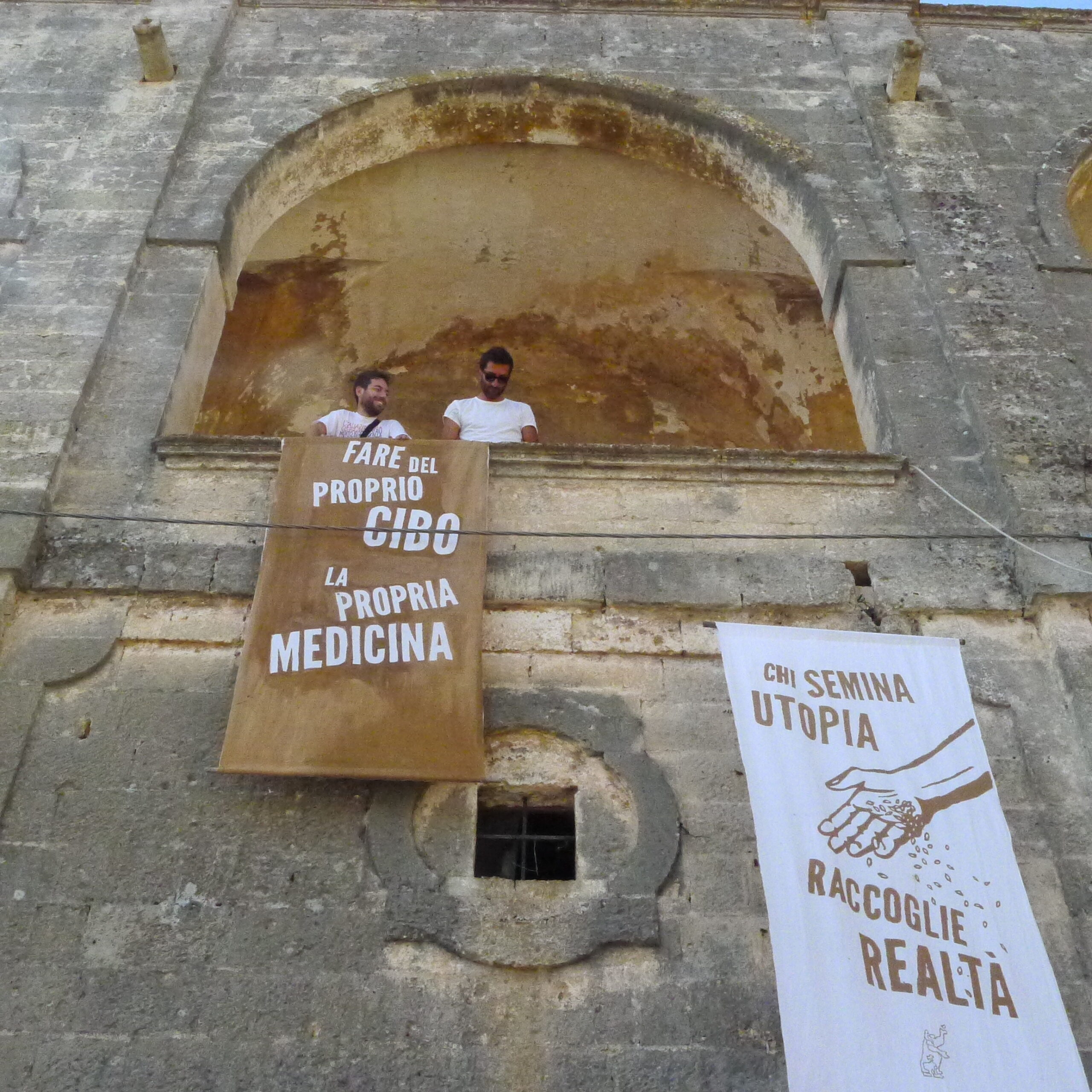
L. We constantly experience the condition of detritus while acting as the Casa delle Agriculture collective. The gloomy landscape caused by the ongoing desiccation of millions of Salento olive trees is the detritus of our monoculture of the mind. Decades before the xylella bacterium began to spread we denounced the ongoing ecocide. Those postcard-worthy olive trees were, at an ecosystem level, a monoculture grown in lands poisoned by herbicides. The challenge we have launched is to cultivate that condition, the result of the emptying of the countryside, the depopulation of the villages, and lack of interest.
For the past seven years we have spent all our energies by laying the foundations of a culture of the common good for the cultivation of our seeds. With the birth of the cooperative and the community mill, the challenge was to think about the economic sustainability of our intervention, which today is still volunteer-based.
M. As you say Luigi, cultivating the condition of detritus means accepting it as a premise for its transformation into a common good in order to give it new meaning. In this sense, the economic sustainability of a community is connected to the creation of a common good. The common good is not a transcendental entity but is defined by a plurality that acts together, a doing that also includes reasoning and mutual recognition.3 For this reason, the sense of common good is produced through social cooperation necessarily passing through deeply democratic inclusive forms that are concerned with economic, social and environmental sustainability and respond to concrete needs, desires and aspirations.
L. We understood that dealing with complex systems means inventing new meanings every time, building a horizon of action to free oneself from a series of cultural, economic, and social constraints. Cultivating land given on loan for temporary use, for example, prompted us to create a widespread rural park, the common park of minor fruits, rather than adapting to the traditional system of large estates. We are equipping a series of paths and infrastructures at the service of reproduction. Such as the mill, the nursery of inclusion, and a series of satellites for organic cultivation, for hospitality and pedagogical actions in quality economic chains linked to agriculture. We realized that in order to create a culture of the common good it is necessary to find concrete management and reproduction alternatives. However, in such an aggressive neoliberal system it is not easy. It requires great dedication, research, and testing. Perhaps the real question we must ask ourselves is how can we teach a culture of the common good starting from the pedagogical relationships already put in place?
M. This is a complex question that is difficult to answer exhaustively. The first thing that comes to mind is that the culture of the common good is taught through a practice that passes through the mutual collective recognition of our diversity. In other words, it means changing the culture of our ego’s boundary, tearing down walls and multiplying thresholds. Stavros Stavrides talks about cities of thresholds. The threshold is a passage, a porous boundary that does not close one subject to another but puts them in communication. I think we need to start from this to teach a culture of the common good, which means experimenting with porosity techniques. However, a pore is nothing more than a filtering space, for the selection of meanings concerning the perturbations to which we are exposed as individual and collective subjects.
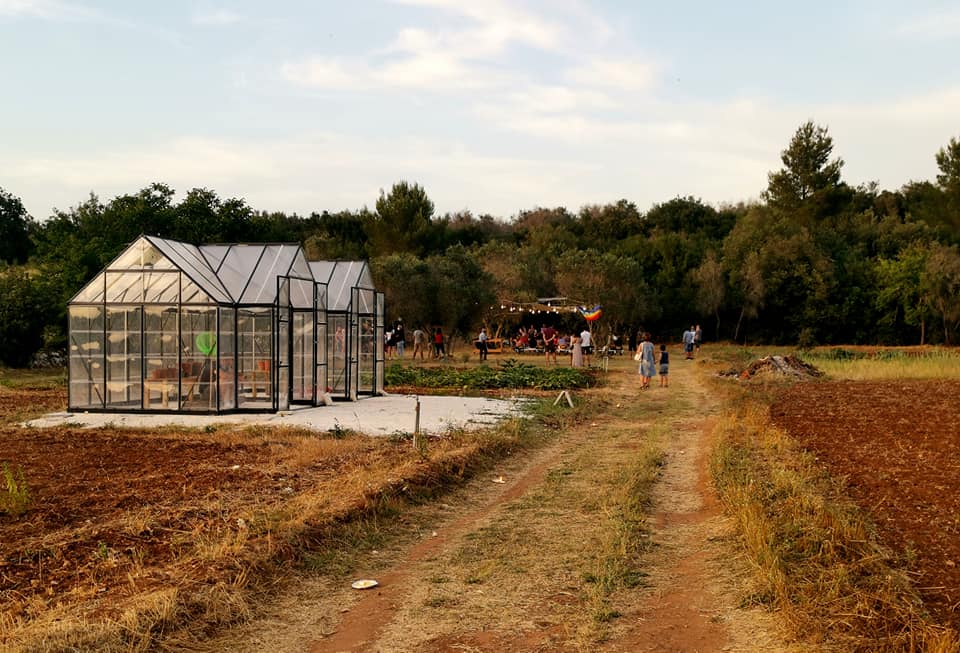
L. I also find this idea of porosity techniques in local traditions. In our case, the idea of nostalgia and sacrifice is very strong. The aspect of female commitment in the fields is very difficult to deal with because it is rooted in the trauma generated by the peasant patriarchal structure. We should consider how the aspect of the reconstruction of rural rituals is an integral part of this system, how celebrating holds communities together. Furthermore in my opinion a culture of the commons is not possible if rituals are not activated. In our experience, the Green Night represents the birth and metamorphosis of a large community that meets and tries to highlight a concrete utopia, in continuous definition.
M. I believe that a crucial aspect of this concrete utopia you are referring to, and that a reality like Casa delle Agriculture pursues, is to lay the foundations for a new social cooperation that not only recalibrates the relationship between human and non-human, but also creates a new meaning to be given to the relationship between urban and rural, i.e. to the territory.
Notes:
1. See for example Vito Teti (2022). La Restanza. Torino: Einaudi.
2. See the definition of detritus in M. De Angelis (2007). The Beginning of History. London: Pluto.
3. For a discussion of the common good and commoning see M. De Angelis (2017). Omnia Sunt Communia. London: Zed.
About the author
Luigi Coppola is an artist who promotes participatory projects and public art and. He is co-activator of Casa delle Agriculture. His work intertwines agricultural and aesthetic practices, developing long-term projects. His research is based on the principles of agroecology and permaculture, focusing on the construction of common goods and communities. He is currently a senior researcher at the Center for Arts Design and Social Science of Boston (USA).